
Understanding Hallmarks and Certifications in Gold and Diamond Jewellery
Jewellery isn’t just about beauty; it’s a symbol of trust, value, and authenticity. Whether it’s a delicate diamond ring or a timeless gold chain, you deserve the assurance that what you’re buying is genuine. This assurance comes through hallmarks and certifications, the silent stamps of credibility that distinguish real jewellery from imitation or low-quality products.
In this guide, we’ll help you understand the importance of hallmarking and certifications in gold and diamond jewellery, how to identify them, and why they matter when purchasing your next precious piece.
Why Hallmarks and Certifications Matter?
When investing in jewellery, you’re not just paying for the design, you’re investing in the purity, authenticity, and long-term value of the metal and gemstones. Unfortunately, the jewellery market can sometimes have misrepresented purity or synthetic stones sold as real.
That’s why trusted jewellers like Babita Agrawal Jewellery provide hallmarked and certified products, giving customers peace of mind and proof of quality.
Here’s why they are essential:
- They validate purity and authenticity.
- They protect you from fraud or misrepresentation.
- They enhance resale value and trust.
- They align with government and international standards.
Hallmarking in Gold Jewellery
1. What is Hallmarking?
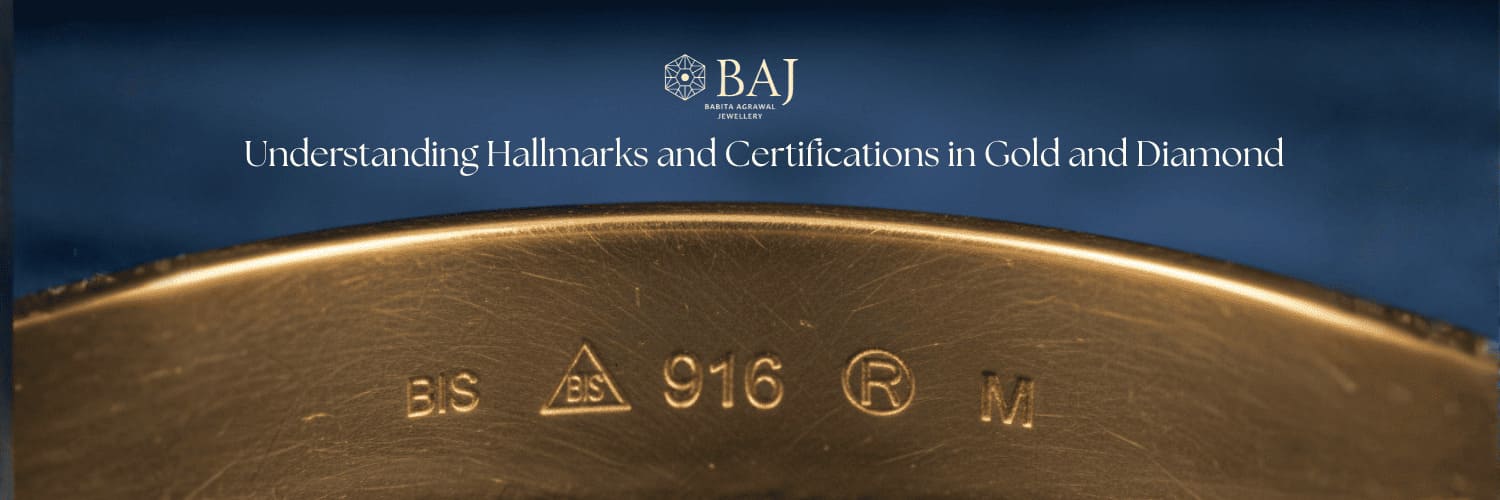
Hallmarking is the process of certifying the purity of gold by authorized government or international agencies. In India, hallmarking is overseen by the Bureau of Indian Standards (BIS), the official body that ensures customers receive the correct quality and purity of gold.
2. Components of a BIS Hallmark
Each hallmarked gold item carries specific symbols and numbers that verify its authenticity. As of 2024, every piece of hallmarked jewellery in India includes the HUID (Hallmark Unique Identification Number), a six-digit alphanumeric code unique to each ornament.
A standard BIS Hallmark consists of:
- BIS Logo – The official mark of authenticity.
- Purity/Fineness Grade – Indicates the karat of gold (e.g., 22K = 91.6% purity, 18K = 75% purity, 14K = 58.5% purity).
- Jeweller’s Identification Mark – The unique code of the jeweller certified by BIS.
- Assaying and Hallmarking Centre Mark – Indicates where the purity was tested.
HUID Number – The latest addition is a unique identification for every piece.
3. Why is BIS Hallmarking Important?
BIS hallmarking ensures:
- You get exact purity as promised.
- The gold is tested in certified laboratories.
- Your jewellery is eligible for resale or exchange anywhere in India.
- It builds trust between buyer and jeweller.
Buying non-hallmarked gold may save a few rupees initially, but it often leads to loss in purity, resale value, and authenticity later.
Understanding Diamond Certifications
Diamonds are complex gemstones; each one is unique. To determine their authenticity, clarity, and quality, professional labs issue diamond certification reports after scientific evaluation.
A certified diamond assures you that what you see is exactly what you’re paying for.
1. What is a Diamond Certification?
A diamond certification (also known as a diamond grading report) is a document issued by a gemological laboratory that describes a diamond’s unique characteristics, such as cut, colour, clarity, and carat weight.
It’s the diamond’s “identity card,” ensuring transparency and authenticity for buyers.
2. Reputed Diamond Certification Bodies
When buying diamond jewellery, always ask for certification from reputed and globally recognised labs. The most trusted ones include:
- GIA (Gemological Institute of America)
The gold standard in diamond grading is known for its accuracy and strict evaluation methods.
Certifications include a detailed analysis of the 4Cs (Cut, Colour, Clarity, Carat). - IGI (International Gemological Institute)
Popular among jewellers worldwide, IGI provides certification for both natural and lab-grown diamonds.
Their reports also include laser inscriptions and diagrams for identification. - HRD (Hoge Raad voor Diamant)
Based in Antwerp, Belgium, HRD offers reliable diamond grading and is known for its European precision. - SGL (Solitaire Gemological Laboratories)
Widely used in India and the Middle East, offering quick and consistent grading for retail diamonds.
At Babita Agrawal Jewellery, every diamond piece is IGI or GIA certified, ensuring unmatched authenticity and brilliance.
3. The 4Cs of Diamond Certification
When evaluating your diamond certificate, always check for the 4Cs:
- Cut – Determines how well the diamond sparkles.
- Colour – Graded from D (colourless) to Z (light yellow or brown).
- Clarity – Indicates internal or external imperfections (flaws).
- Carat Weight – Refers to the diamond’s size and weight.
Understanding these grades helps you compare diamonds objectively and make an informed purchase.
Difference Between Hallmark and Certification
Feature | Hallmark (Gold) | Certification (Diamond) |
Purpose | Ensures purity of metal | Confirms the authenticity and quality of the diamond |
Authority | Bureau of Indian Standards (BIS) | GIA, IGI, HRD, or SGL |
Scope | Applies to gold and silver jewellery | Applies to natural or lab-grown diamonds |
Mandatory? | Yes, in India | Optional but recommended |
Marking | Physical stamp with BIS logo and HUID | Paper or digital report linked to a diamond |
Both are equally important; hallmarking assures the purity of gold, while certification verifies the authenticity of diamonds.
How to Verify Hallmarks and Certificates Online?
Today, buyers can easily verify authenticity online using official tools:
For Gold:
- Visit the official BIS Care App (available on Android and iOS).
- Enter the HUID number on your jewellery.
- You’ll instantly get details of purity, jeweller, and hallmarking centre.
For Diamonds:
- Visit the official website of the certification body (e.g., GIA Report Check or IGI Verify).
- Enter the report number mentioned on the certificate or inscribed on the diamond.
- Verify all grading details instantly.
Tips for Buying Certified Jewellery
When investing in gold or diamond jewellery, follow these golden rules:
- Always buy from reputed jewellers like Babita Agrawal Jewellery who provide full certification.
- Check the BIS hallmark and HUID number before making a payment.
- For diamond jewellery, ask for a GIA or IGI certificate.
- Avoid sellers who hesitate to show authenticity documents.
- Keep copies of certificates and invoices for future resale or insurance.
The Role of Babita Agrawal Jewellery in Ensuring Authenticity
At Babita Agrawal Jewellery, transparency, trust, and quality are at the core of every creation. Every gold ornament is BIS hallmarked with an HUID number, and every diamond piece carries an IGI or GIA certification.
By maintaining international grading standards and craftsmanship excellence, BAJ ensures that customers receive not just jewellery, but a symbol of purity and value.
Conclusion
Hallmarks and certifications are your safety shield against counterfeit or low-quality jewellery. They represent trust, purity, and assurance values that every jewellery buyer deserves.
So, before you invest in that glittering necklace or diamond ring, always look for these marks of authenticity. Remember, the beauty of jewellery lies not only in its sparkle but in the truth behind its craftsmanship.
Choose Babita Agrawal Jewellery, where every piece is hallmarked, certified, and made with integrity.
About Author

Babita Agrawal
Babita Agrawal is a visionary jewellery designer with over 30 years of experience in the industry. Founder of Babita Agrawal Jewellery, she began her journey from a small cabin and built one of Mumbai’s most admired boutique jewellery brands. Her commitment to blending traditional aesthetics with modern artistry defines each elegant creation, making her a respected name in luxury jewellery.