
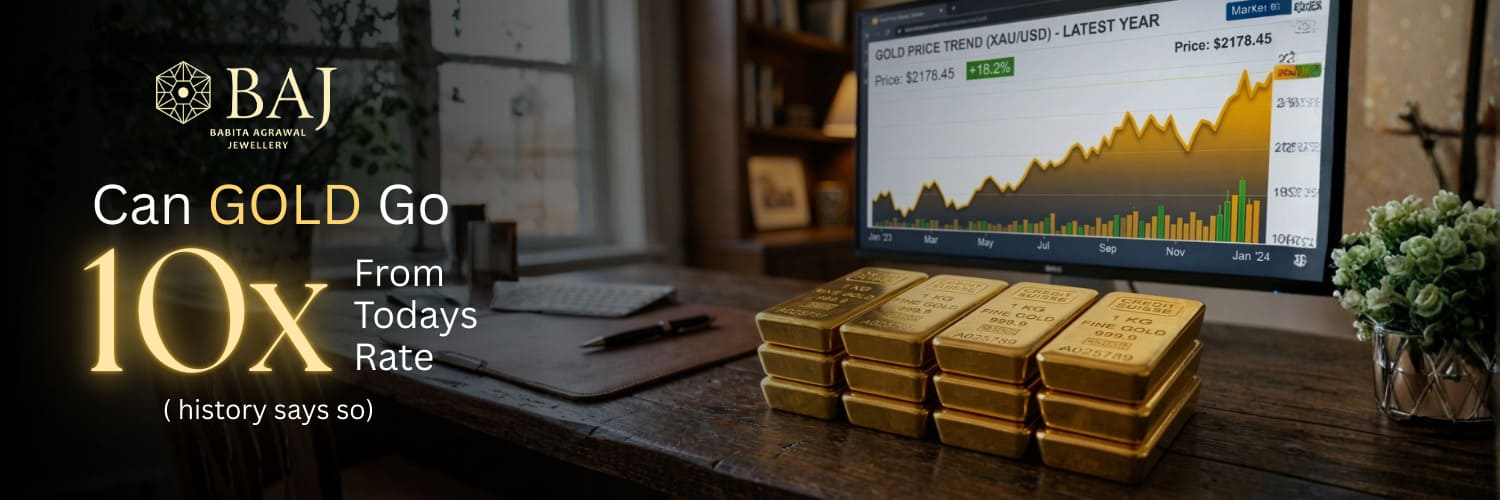
Can Gold Prices Grow 10X From Today? What Historical Data Suggests
Gold has fascinated investors, economists, and families for centuries. In India, especially, gold is more than just a precious metal it represents wealth, security, and tradition. From jewellery purchases during festivals to long-term investment strategies, gold continues to hold a unique position in financial planning.
But a bold question often comes up among investors: Can gold prices grow 10X from today’s levels? At first glance, this might sound unrealistic. However, history shows that gold has delivered extraordinary long-term growth over several decades. To understand whether a 10X rise is possible, we need to examine historical price trends, economic drivers, and long-term market behaviour.
The Historical Journey of Gold Prices
One of the most compelling reasons investors remain bullish about gold is its remarkable long-term price appreciation.
If we look back several decades, gold prices were dramatically lower than they are today. In India, the price of gold was around ₹63 per 10 grams in 1964, whereas by 2026, it had risen close to ₹1,50,000 per 10 grams.
This means gold has increased thousands of times over multiple decades. Even in recent years, growth has been significant. Around 2000, gold traded at approximately ₹4,400 per 10 grams; since then, prices have increased more than 15-fold.
These numbers clearly show that gold has the capacity to multiply in value over long time periods. But this growth usually occurs gradually rather than overnight.
Understanding Gold’s Long-Term Returns
Gold is often considered a stable asset because it grows steadily over time rather than producing sudden exponential returns like some stocks or cryptocurrencies.
Historical data shows that gold in India has delivered around 9-11% average annual returns over long periods.
This may not seem extraordinary at first, but when compounded over several decades, these returns can result in massive price growth.
For example:
- A 10% annual growth rate means prices roughly double every 7–8 years.
- Over 30 years, that growth can multiply several times.
- Over 50 years, even moderate returns can produce extremely large gains.
This is why investors who bought gold decades ago often see dramatic appreciation today.
When Has Gold Seen Explosive Growth?
Although gold usually moves steadily, there have been certain periods where prices surged dramatically.
1. The Inflation Era of the 1970s
During the 1970s, global inflation and currency instability caused gold prices to rise sharply. Investors turned to gold as protection against falling purchasing power.
2. The Global Financial Crisis (2008-2011)
When financial markets collapsed during the global financial crisis, gold became a safe-haven asset. Prices surged as investors moved away from risky investments.
3. The Pandemic Period (2020)
Economic uncertainty during the COVID-19 pandemic pushed gold to record levels as investors sought security.
4. Recent Geopolitical Tensions
Recent years have seen strong gold demand due to geopolitical uncertainty and economic instability, with prices reaching new highs in India.
These events demonstrate that gold tends to perform particularly well during global uncertainty.
Could Gold Realistically Grow 10X?
To understand the possibility of a 10X increase, we must look at time horizons.
If gold were to grow 10 times from current levels, prices would need to rise dramatically. However, historical data show that such growth usually takes several decades.
For example:
- Gold increased from around ₹99 per 10 grams in 1950 to nearly ₹1 lakh by 2025.
- Over long periods, this represents massive multiplication in value.
This suggests that a 10X increase is theoretically possible but likely over a long time frame rather than in the near future.
Investors expecting such growth within a few years may be disappointed, but those thinking in terms of decades might see substantial appreciation.
Key Factors That Could Push Gold Prices Higher
Several economic and geopolitical factors could influence gold’s long-term growth.
1. Inflation
Inflation erodes the value of currency over time. Historically, gold has served as a hedge against inflation by preserving purchasing power.
2. Central Bank Demand
Central banks around the world have been increasing their gold reserves. This institutional demand can support long-term price growth.
3. Currency Weakness
If major currencies weaken, gold often becomes more attractive because it retains intrinsic value.
4. Global Uncertainty
Wars, economic crises, and geopolitical tensions typically increase demand for gold as investors look for safer assets.
5. Growing Investment Demand
The popularity of gold ETFs, digital gold, and sovereign gold bonds has made gold investment more accessible, increasing overall demand.
Why Gold Rarely Moves in Straight Lines?
Despite its long-term growth, gold does not rise consistently every year. Prices often go through cycles.
There are periods where gold remains flat or even declines for several years. These phases usually occur when global economies are stable, and investors prefer higher-return assets like stocks.
However, gold often rebounds strongly during economic instability. This cyclical nature is one reason why gold remains valuable as a diversification tool in investment portfolios.
The Psychological Power of Gold
Beyond financial returns, gold holds strong psychological value. During uncertain times, investors instinctively trust gold because of its long history as a store of wealth.
This psychological factor often drives demand during crises, contributing to sudden price rallies.
In countries like India, where gold ownership is deeply embedded in culture, this emotional connection further strengthens demand.
So, Can Gold Really Grow 10X?
The short answer is: yes, but likely over a long period of time.
History clearly shows that gold has multiplied many times over the decades. From a few hundred rupees per 10 grams decades ago to nearly one lakh today, the journey itself proves gold’s long-term potential.
However, expecting a 10X rise in the near future would require extraordinary global economic conditions. Realistically, such growth would probably unfold gradually over several decades.
For investors, the key lesson is not to chase unrealistic timelines but to view gold as a long-term wealth preservation asset.
The Enduring Value of Gold: A Long-Term Perspective
Gold’s history is a story of patience. It has survived wars, financial crises, currency collapses, and economic transformations while continuing to maintain value.
While predicting the exact future price of gold is impossible, historical trends suggest that long-term investors often benefit from holding the metal through multiple economic cycles.
Whether you buy gold for tradition, security, or investment diversification, the key is to think long term rather than focusing on short-term price movements.
Explore our trusted gold collection at Babita Agrawal Jewellery today and start building a timeless investment that combines tradition, security, and long-term value.
About Author

Babita Agrawal
Babita Agrawal is a visionary jewellery designer with over 30 years of experience in the industry. Founder of Babita Agrawal Jewellery, she began her journey from a small cabin and built one of Mumbai’s most admired boutique jewellery brands. Her commitment to blending traditional aesthetics with modern artistry defines each elegant creation, making her a respected name in luxury jewellery.